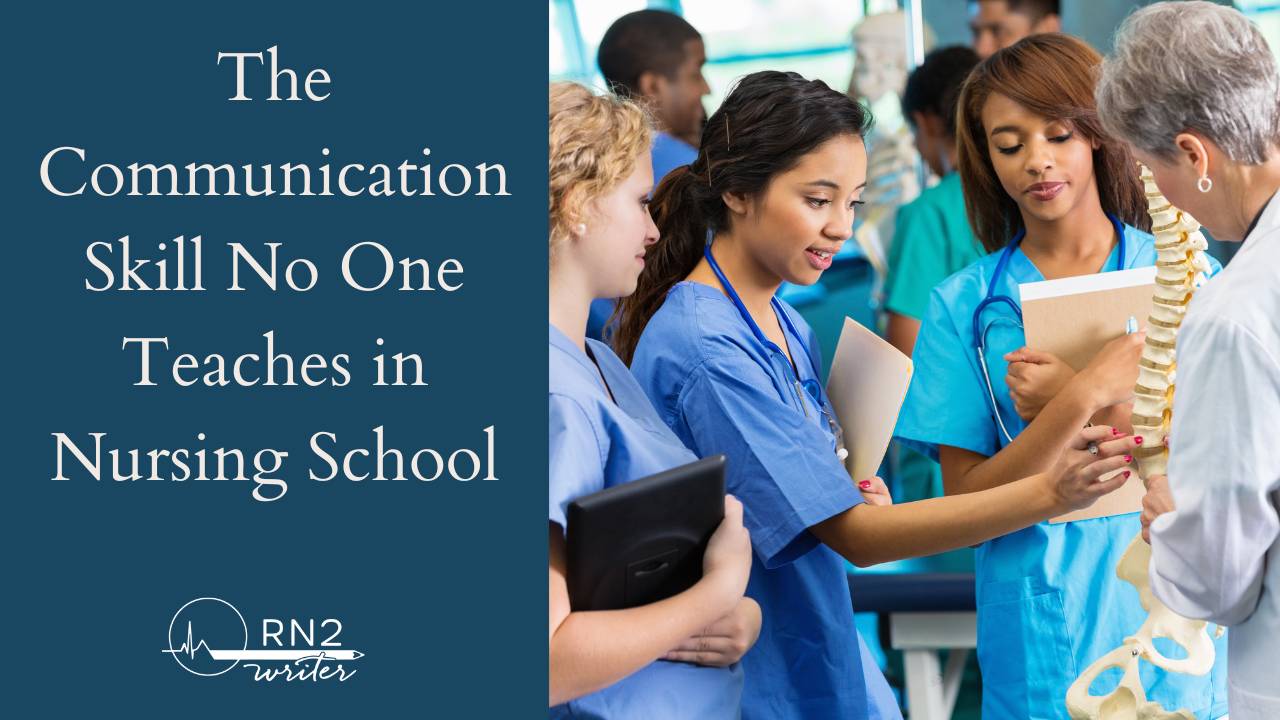
The Communication Skill No One Teaches in Nursing School
In This Article
- Nursing school trains nurses to communicate with patients, families, and clinical colleagues, but not with organizational leadership
- Upward communication — the ability to write and speak effectively with people above you in an organizational hierarchy — is a distinct skill with its own rules
- Most nurses learn upward communication by trial and error, if they learn it at all
- The gap between clinical communication skill and organizational communication skill is where many nursing careers quietly stall
- Upward communication can be taught, practiced, and improved — it is not a natural talent reserved for a few
Nursing school is rigorous. The communication training alone covers more ground than most people outside the profession realize.
Therapeutic communication with patients. Delivering difficult news to families. Structured clinical handoffs. Interdisciplinary collaboration. Documentation that is accurate, legally sound, and clinically complete. Nurses graduate with a communication toolkit that most other professions spend years trying to build.
And then they walk into their first job and discover that there is an entire category of professional communication their training never touched.
The Skill That Is Missing
The skill is upward communication.
Upward communication is the ability to write and speak effectively with people who hold organizational authority over you. Managers, Directors. Administrators. Executives. The people whose decisions shape your working conditions, your career trajectory, and the quality of care your patients receive.
It is a distinct skill. It operates by different rules than clinical communication, peer communication, or patient communication. It requires a different sense of audience, a different structure, and a different understanding of what counts as relevant information.
Nursing school does not teach it. Most nursing continuing education does not teach it. Most hospital orientation programs do not teach it. Nurses are expected to figure it out on their own, and the ones who do not are often the ones who wonder, years into their careers, why their ideas never seem to gain traction and why colleagues with less experience keep moving ahead of them.
A Few More to Explore on This Topic
- How to Advocate Professionally in Nursing Without Sounding Confrontational
- How Strong Documentation Skills Protect Your Nursing License
- What Strong Written Communication Signals to Nurse Leaders
- How to Write Clear, Professional Emails in Healthcare
- Why SBAR Works in the ICU But Falls Apart in the Boardroom
Why It Is Different From What Nurses Already Know
Clinical communication is built for shared context. When a nurse communicates with a physician, a colleague, or even a patient, there is a foundation of shared understanding to work from. Both parties understand what a patient room looks like, what a shift feels like, what the stakes are when something goes wrong.
Organizational leadership often does not share that context. They are operating at a different altitude, managing systems and budgets and competing priorities that a bedside nurse rarely sees. Communicating effectively with that audience means understanding what they care about, what they need to make a decision, and how to frame a nursing concern in terms that connect to organizational priorities rather than clinical ones.
That translation work is sophisticated. It is also learnable. But it requires someone to teach it, and right now, almost no one is.
What Happens When Nurses Learn It
Nurses who develop strong upward communication skills do not just advance faster, though they often do. They become more effective advocates for their patients and their units. They get their proposals taken seriously. They are invited into conversations that used to happen without them. They stop feeling like their voice disappears the moment it leaves the bedside.
The skill changes the scope of what is possible. A nurse who can only communicate effectively at the bedside can influence outcomes for the patients in their care. A nurse who can also communicate effectively with organizational leadership can influence outcomes for every patient on the unit, every nurse on the floor, and every policy that shapes how care gets delivered.
That is not a small difference. It is the difference between being good at nursing and being able to change what nursing looks like.
Nursing school gave you the foundation. Upward communication is what you build on top of it.
Join 44,000 Nurses Who Read ShiftNotes Every Wednesday - Plus Get the Paid-to-Write Protocol FREE
Become a health writer in one afternoon with my mini-training, The Paid-to-Write Protocol. Find your first 10 magazines to pitch using my proven method.
All free, just for subscribing to my weekly newsletter ShiftNotes:
We hate SPAM. We will never sell your information, for any reason.
Author