
Journaling for Nurses: A Simple Practice for Stress Relief and Mental Clarity
In This Article
Journaling for nurses is a simple, flexible tool for stress relief, emotional processing, and mental clarity. It doesn’t require a paper notebook or long, time-consuming entries. Nurses can journal using voice memos, notes apps, or short structured reflections after a shift. Even five minutes of intentional reflection can reduce burnout and improve emotional resilience.
Nursing is emotionally dense work.
You move from room to room.
Crisis to crisis.
Task to task.
...And then you go home.
What often doesn’t happen?
Processing.
Most nurses don’t lack resilience.
They lack decompression space.
Journaling is one of the simplest, most accessible tools for stress relief — and it does not have to look like sitting at a desk with a leather-bound notebook for 45 minutes.
It can be simple.
Short.
Flexible.
Private.
And it can dramatically change how you carry your work home.
What Journaling for Nurses Actually Is (And Isn’t)
Journaling is not:
- Writing beautifully
- Producing something publishable
- Creating a diary for someone else to read
- Spending an hour reliving your shift
Journaling is simply:
Intentional reflection in words.
That’s it.
It’s the act of giving structure to thoughts that would otherwise stay tangled.
When you put language around an experience, your brain begins to process it differently.
That matters in a profession filled with unspoken moments.
A Journal Doesn’t Have to Be Paper
Let’s remove the biggest barrier first.
You do not need:
- A physical journal
- A perfect pen
- A quiet house
- A ritual
You can journal in ways that fit real life.
Examples:
- A notes app on your phone
- A private Google Doc
- A password-protected document
- A simple email draft to yourself
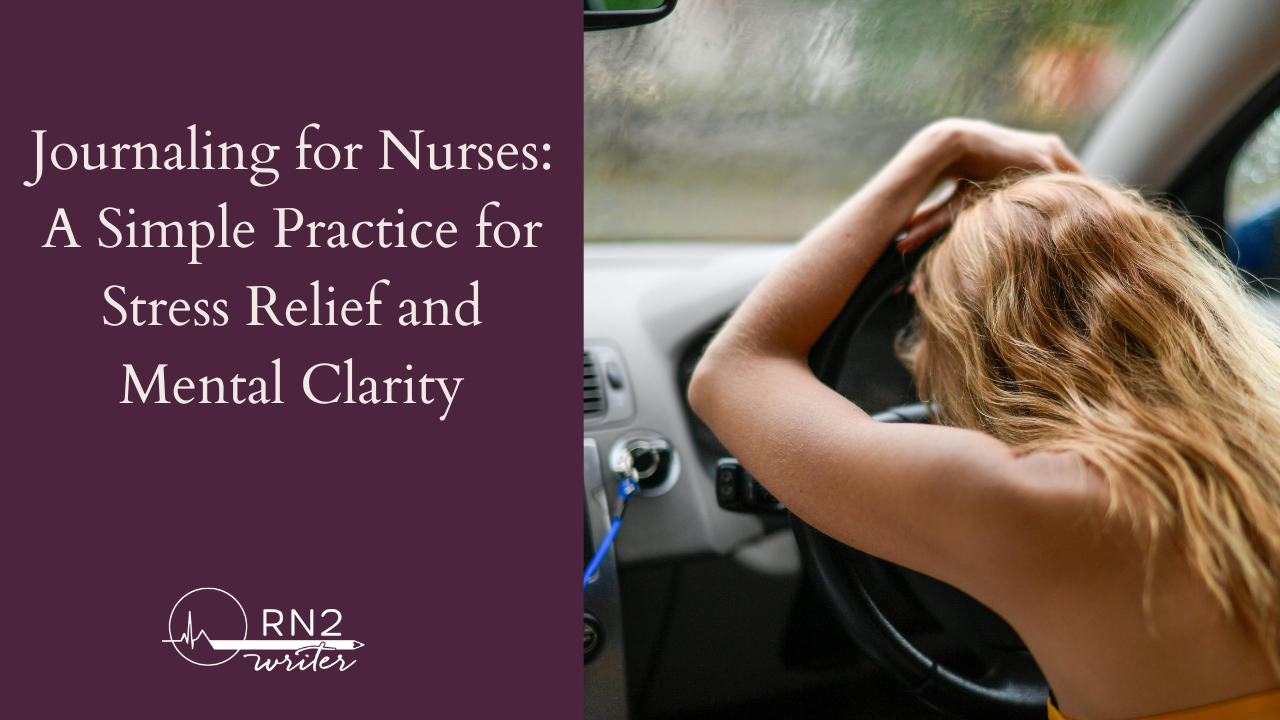
- A voice memo dictated in your car after shift
Yes — a voice memo counts.
If you leave work and sit in your car for three minutes and say:
“Today was heavy. I felt frustrated when…”
That is journaling.
The medium doesn’t matter.
The reflection does.
Journaling Doesn’t Have to Be Long
Another myth:
“If I can’t write a full page, it’s not worth it.”
Not true.
Five sentences can be enough.
Two minutes can be enough.
Consistency matters more than length.
A short, structured reflection done regularly will do more for stress relief than occasional long entries.
Think small.
Think sustainable.
Why Journaling Helps Nurses
Nurses absorb a tremendous amount:
- Patient suffering
- Family dynamics
- Team conflict
- Moral distress
- System frustrations
Often without a safe outlet.
Journaling provides:
- Emotional processing
- Cognitive clarity
- Stress reduction
- Perspective
- A sense of control
It helps separate:
What happened from what you are carrying.
That distinction is powerful.
A Simple 3-Part Structure You Can Use Tonight
You don’t need complicated prompts.
Here is a simple structure that works well for nurses:
1. What happened?
Stick to facts.
Briefly describe one moment from your shift.
No editing.
No overthinking.
2. How did I feel about it?
Name the emotion.
Frustrated.
Overwhelmed.
Proud.
Angry.
Grateful.
Disappointed.
Even one word matters.
3. What do I want to release or remember?
This is the processing step.
You might write:
“I’m releasing the guilt from that interaction.”
“I want to remember how well our team handled that code.”
“I’m choosing not to carry that conversation home.”
This step creates closure.
Without it, your brain keeps looping.
Journaling as Emotional Hygiene
You brush your teeth daily.
You wash your hands repeatedly during a shift.
But emotional hygiene?
That’s rarely taught.
Journaling can become a small, consistent reset between work and home.
It draws a boundary.
It says:
“I am not ignoring what happened. I am acknowledging it — and setting it down.”
That’s different from suppression.
It’s intentional release.
This Is Not About Becoming a Writer
You do not need to be “good at writing.”
You don’t need grammar.
You don’t need structure beyond what helps you think clearly.
This is not about productivity.
It’s about processing.
And the beauty of journaling is that it belongs entirely to you.
No audience.
No evaluation.
No performance.
A Gentle Starting Point
If the idea feels overwhelming, start here:
After your next shift, take two minutes.
Open your notes app or record a voice memo.
Answer:
- What stood out today?
- How do I feel about it?
- What am I leaving at work?
That’s enough.
Over time, this small practice can reduce stress, increase self-awareness, and strengthen emotional resilience.
In a profession where so much is given outwardly, journaling is one quiet way to give something back to yourself.
Nursing asks everything of you. Writing can give some of it back. If you're ready to explore what that looks like, Write to Release: Journaling for Stress Relief, Emotional Processing and Renewal walks you through it gently — at your own pace, in your own words. [Learn more here.]
Join 44,000 Nurses Who Read ShiftNotes Every Wednesday - Plus Get the Paid-to-Write Protocol FREE
Become a health writer in one afternoon with my mini-training, The Paid-to-Write Protocol. Find your first 10 magazines to pitch using my proven method.
All free, just for subscribing to my weekly newsletter ShiftNotes:
We hate SPAM. We will never sell your information, for any reason.
Author